
Figures below come from APA guides, the 2021 International Residential Code, LP and Georgia-Pacific product documents, and dated retail listings. Verified November 2026.
The Quick Info
T1-11 siding is a 4-foot-wide structural panel with vertical grooves cut into the face. The name is short for Texture 1-11, an APA trade name for a specific APA 303 rated siding panel. (APA 303 is the grading standard for plywood siding.) The classic version is all-veneer plywood. Panels made from strands, like LP SmartSide, give you the same grooved look on an OSB-type core.
It makes good sense on sheds, barns, shops and simple cabins. One sheet can serve as both siding and wall bracing. As of November 2026, a 19/32-inch plywood T1-11 sheet listed at $44.78 at Home Depot.
No T1-11 panel is waterproof. Plywood swells less than OSB when soaked, and strand panels depend on the maker’s treatment and install rules.
T1-11 rarely fails in the middle of the sheet. It fails at the bottom edge and at the joints. APA tells you to seal the lower drip edges with extra care because they get wet the most. Get those details right and T1-11 can serve you a long time.
What Is T1-11 Siding?

I’ve spent more than 35 years in Gulf Coast lumber yards, and T1-11 has been on the rack the whole time. Folks call any grooved panel “T1-11.” Technically, it’s more specific.
According to APA’s siding overview, Texture 1-11 is an all-veneer panel with shiplapped edges and parallel grooves 1/4 inch deep and 3/8 inch wide. Standard groove spacing is 4 or 8 inches on center, meaning measured from the center of one groove to the next. The shiplap hides the vertical seam.
Georgia-Pacific’s Plytanium plywood siding page lists T1-11 at 4 or 8 inches on center, in 11/32 and 19/32 performance categories. Those sheets measure 0.328 and 0.578 inch thick. The face is “rough sawn or scratch sand.” Home Depot also lists a 5/8-inch Douglas fir T1-11 panel at 4 by 10 feet.
So how thick is T1-11? Most sheets are sold as 11/32, 3/8, 19/32 or 5/8 inch nominal. For siding nailed straight to studs, I steer people to 19/32 or 5/8 inch.
The grade stamp tells you more than the label does. APA’s 303 siding series grades the face by how many patches it can carry. The APA Engineered Wood Construction Guide lists grades from 303-OC, the most restrictive, through 303-30, the least. “W” means wood patches, “S” means synthetic, and the number caps the patch count.
The stamp also carries a span rating, like 16 oc or 24 oc. That number is the maximum stud spacing in inches.
Plywood vs OSB T1-11: Which Holds Up Better?
This is the question I get most at the counter.
The clearest numbers come from APA testing, cited in Professional Roofing’s “Plywood or OSB?” (NRCA, April 2021). From oven dry to vacuum soak, 1/2-inch plywood swelled 9.4 percent in thickness on average. The 7/16-inch OSB swelled 32.9 percent. It’s a harsh lab test, and the panels weren’t the same thickness, so don’t read it as field performance. It does show which way each one leans.
That’s why modern strand siding is a treated product, not raw OSB with grooves. LP says its SmartSide panels are made with waxes, resins and zinc borate for resistance to fungal decay and termites.
| Factor | Plywood T1-11 | Strand (OSB-type) panel, e.g. LP SmartSide |
|---|---|---|
| Core | Wood veneer plies | Wood strands with resin and wax |
| Swell when soaked (APA test) | 9.4% (1/2-inch plywood) | 32.9% (7/16-inch OSB) |
| Finish options | Paint or stain, matched to face grade | LP: acrylic or oil paint only, no stain |
| Finish deadline | None stated by APA | LP: paint within 180 days |
| Cut edges | APA: seal before install, reseal cuts | LP: seal all exposed cuts |
| Price, 4×8 sheet (Nov. 2026) | $44.78 (19/32-inch) | $45.78 (3/8-inch LP 38 Series) |
Prices are Home Depot online listings for a central Texas store, checked November 21, 2026. Lowe’s showed the same $44.78 for plywood. I couldn’t find generic, untreated OSB T1-11 at either big box. The LP sheet ran within a dollar of plywood.
What I Reject at the Lumber Yard
Pull every sheet yourself if the yard lets you. A good plywood T1-11 face looks flat and even, with clean groove walls and tight shiplap edges.
Here’s my checklist.
- No APA stamp. If it isn’t stamped as rated siding, it isn’t T1-11. It’s grooved plywood.
- Swollen or flared edges. Strand panels that sat in the rain will show it at the edges first. I pass on those.
- Wet or dark sheets in the middle of the bunk. Moisture trapped in a stack means trouble before you start.
- Broken shiplap edges. A chipped lap leaves you a seam that leaks.
- Delamination at the edges. On plywood, look for plies that have separated.
- Heavy patching on a face you plan to stain. Patches show through semitransparent stain.
On the coast, I watched a lot of strand panels come back after a humid summer. Customers had stacked them outside under a tarp, right on the ground, and the bottom edges swelled before a nail went in. APA says to store panels cool and dry. If they must stay outside, keep them off the ground on stickers, cut the straps, cover them and leave room for air to move.
Is T1-11 Good for Exterior Siding? Where It Works and Where It Doesn’t
Yes, on sheds, barns, shops and other buildings where cost and speed matter most. On a primary home in a wet climate, it’s a weaker choice. The code also gives it a structural job.
In the 2021 IRC wall construction chapter, bracing Method WSP calls for wood structural panels at least 3/8 inch thick. They’re nailed 6 inches on center at edges and 12 in the field. APA says panel siding installed per its details meets code bracing requirements. One layer does the work of sheathing and siding.
Section R703.5.2 of the 2021 IRC wall covering chapter sets limits. Three-eighths-inch panel siding can’t go directly on studs more than 16 inches on center when the long side runs parallel to the studs. Stud spacing also can’t exceed the panel’s span rating.
Shed builders should know the IRC exempts one-story detached accessory structures up to 200 square feet from permits. Local rules vary, so call your building department before you build.
| Project | Climate | My verdict |
|---|---|---|
| Storage shed or garden shed | Any | Use it, with sealed edges and 6-inch clearance |
| Barn, shop or garage outbuilding | Dry to moderate | Use it |
| Barn, shop or garage outbuilding | Humid or high rain | Use it with wide overhangs and good flashing, or step up to treated strand panel |
| Hunting cabin or seasonal camp | Any | Use it if you’ll maintain the finish |
| ADU or guest house | Any | Think twice. Compare LP or fiber cement panel |
| Primary home | Humid, wet or coastal | Skip it |
| Primary home | Dry | Workable, but budget for upkeep |
The product isn’t junk. A house just has more joints, trim and penetrations than a shed. Each one is a place for water to sit against an edge.
How to Install T1-11 Siding So It Lasts
Most T1-11 failures I’ve seen trace back to the install.
Hang the sheets vertically with the grooves plumb. Start at a corner, check the first sheet with a level, and let each new sheet’s shiplap edge lock over the one before it. If you cut with a circular saw, cut with the good face down so splinters land on the back.
Clearance to Grade, Bottom-Edge Sealing and Drip Edge
APA’s details show a 6-inch minimum clearance from siding to grade. The IRC backs it up for decay reasons. Section R317.1, in the 2021 IRC building planning chapter, requires decay-resistant or preservative-treated wood for exterior siding less than 6 inches from the ground. The same section sets a 2-inch minimum above concrete steps, porch slabs and patios.
LP’s SmartSide panel application instructions use the same 6 inches to grade. They require at least 1 inch above porches, patios and walkways. That’s less than the IRC’s 2 inches, so on a permitted job, follow the code.
Then seal that bottom edge. APA says moisture enters end grain faster than the face, and horizontal edges, “particularly lower drip edges,” need careful sealing. If you’re painting, seal edges with the same primer you’ll use on the face. If you’re staining, use a paintable water-repellent sealer.
APA’s details also show flashing to separate siding from a concrete foundation.
Z-Flashing at Horizontal Joints
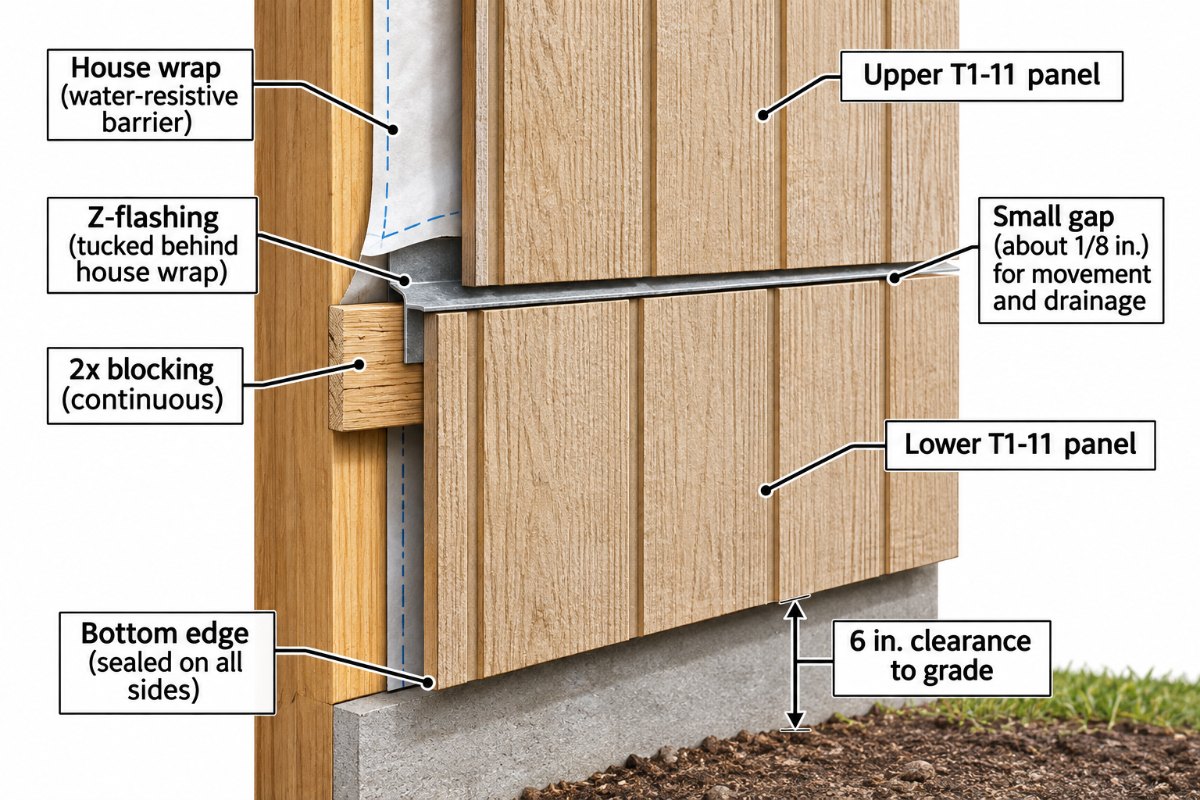
Horizontal joints are the second place T1-11 fails.
The IRC says horizontal joints in panel siding must be lapped at least 1 inch, shiplapped, or flashed with Z-flashing. They must also land over solid blocking or wood structural panel sheathing. APA’s Z-flashing detail for rated siding shows the flashing lapped under the water-resistive barrier above. It leaves a 1/8-inch gap “to prevent wicking.” LP calls for a minimum 3/8-inch gap and Z-flashing at horizontal seams on its square-edge panels.
Never caulk the bottom of that gap shut. It’s there to let water out.
Water-Resistive Barrier, Fasteners and Spacing
On a house, the IRC requires at least one layer of water-resistive barrier over studs or sheathing on all exterior walls. APA and LP both call for a barrier behind panel siding.
Many shed builders skip the wrap. On anything you heat or live in, wrap it.
For fasteners, the IRC’s Table R703.3(1) lists wood structural panel siding at 3/8 to 1/2 inch. It calls for a 2-inch by 0.099-inch siding nail direct to studs, or 2-1/2 inch by 0.113-inch over sheathing. Space them 6 inches at edges and 12 at intermediate supports.
APA recommends hot-dip galvanized nails. Stainless steel or aluminum performs best, and near salt air on the coast, I’d pay for stainless. Keep nails 3/8 inch from panel edges.
APA also recommends a 1/8-inch gap at all edge and end joints unless the panel maker says otherwise. Don’t glue siding to framing. APA says glue raises the risk of buckling.
Prime All Edges and the Back Before Install
APA notes that edges can be sealed while the panels are still stacked. Reseal any edge you cut on site.
APA’s guide doesn’t require back-priming, but I recommend it on any wall that takes weather. On LP panels, follow LP’s rules instead.
Painting T1-11 Siding (and Staining It)
For painting T1-11 siding made of plywood, APA’s advice is clear. Semitransparent oil stain is only for the cleanest face grades, which are 303-OC, 303-NR and 303-6-W. Most other grades should get solid-color stain or paint. APA says the best overall performance comes from an all-acrylic latex paint system.
Georgia-Pacific’s Plytanium FAQ calls for one coat of acrylic latex primer and at least two coats of acrylic latex paint. It does not recommend oil-based paint.
LP’s rules are stricter. Paint all exposed surfaces, including drip edges. Use acrylic exterior paint made for wood and engineered wood. Oil paint is acceptable. Do not use stain, and paint within 180 days.
Rough-sawn faces drink finish. Paint on a dry day when the wood itself is dry, and back-brush or back-roll so the coating gets into the texture and grooves.
How to Make T1-11 Siding Look Better
Most “ugly T1-11” is a finish problem hiding a bottom-edge problem.
- Probe the bottom 12 inches. Push an awl into the bottom edge and the grooves. Soft wood means replacement, not paint.
- Fix the clearance first. Pull soil or mulch back so you have 6 inches to grade.
- Replace bad sheets. Swap the full sheet, or cut a horizontal joint over new blocking and Z-flash it.
- Clean, scrape and spot-prime. Prime bare wood and every exposed edge.
- Paint with acrylic latex. Use two topcoats over primer.
- Consider battens. APA’s horizontal panel details use battens at 4 or 8 feet on center to cover butt joints. On a vertical install, battens nailed over grooves at 16 or 24 inches turn tired T1-11 into a board-and-batten look. Nails through battens must reach at least 1 inch into studs.
One old barn on a customer’s place near the bayou still had sound T1-11 after about 30 years. It had a 2-foot overhang, a gravel strip at the base and fresh paint every few years.
Replacing instead? Our guide to lap siding options covers horizontal alternatives. For a manufactured home, see our exterior mobile home siding ideas.
T1-11 vs LP SmartSide (and Other Alternatives)
| Product | 4×8 sheet price (Nov. 2026) | Installed cost per sq ft | Warranty |
|---|---|---|---|
| Plywood T1-11 | $44.78 (19/32-inch) | $2.50 to $8.00 | None listed on GP product page |
| LP SmartSide panel | $45.78 (38 Series, 3/8-inch) | $7 to $12 (engineered wood) | 5-year 100%, 50-year prorated |
| Hardie Panel, Sierra 8 | $59.98 | Not in same source | 30-year non-prorated substrate |
| Wood board and batten | Not sold by sheet | $5 to $14 | Varies by species and mill |
On T1-11 vs LP SmartSide, the sheets cost about the same. Plywood T1-11 can be stained and has looser finish rules. LP adds rot and termite treatment and a 5/50 warranty, but only if you paint it and install it exactly to LP’s rules.
Sheet prices are Home Depot listings checked November 21, 2026. Installed costs come from HomeGuide’s wood siding cost guide, dated June 2025. HomeGuide’s engineered wood range covers the category, not LP panels alone.
LP SmartSide panel. LP’s 5/50 warranty explainer describes five years of 100 percent labor and material replacement. After that comes a 50-year prorated material-only feature. The catch is that LP says skipping its instructions voids coverage for the affected products. LP 38 Series panels go direct to studs at 16 inches on center, and 190 Series can span 24.
Fiber cement panel. James Hardie’s Hardie Panel page lists a 30-year non-prorated, transferable substrate warranty. Sierra 8 gives a grooved look at about $15 more per sheet than plywood in the listings I checked. Fiber cement won’t rot, though it’s heavier and harder to cut than wood. Our Allura fiber cement siding review covers another fiber cement brand.
Pressure-treated T1-11. Standard T1-11 isn’t pressure-treated, but YellaWood sells T1-11 treated with micronized copper for above-ground use. It carries a lifetime limited warranty, per the YellaWood T1-11 page.
Board and batten or log looks. Real wood board and batten costs more installed. For a cabin look, our TruLog siding review and cost breakdown covers a steel log-profile option.
How Much Does T1-11 Siding Cost?
Plywood T1-11 runs about $35 to $45 per 4×8 sheet, or $2.50 to $8.00 per square foot installed. On November 21, 2026, Home Depot listed 11/32-inch plywood T1-11 at $35.48 a sheet, about $1.11 per square foot. The 19/32-inch sheet at $44.78 works out to about $1.40, and the LP panel to about $1.43.
HomeGuide puts plywood T1-11 at $0.90 to $2.50 per square foot for materials. It puts the installed cost at $2.50 to $8.00 per square foot. Trim, flashing, wrap, paint and tear-off move that number.
Be careful saving money on thickness. The 11/32-inch sheet saves about $9 a sheet. APA says 3/8 inch or a sheet rated Siding 16 oc is the minimum it recommends direct to framing. The IRC table lists wood structural panel siding at 3/8 to 1/2 inch. On a permitted job, ask your building official before you hang 11/32-inch sheets. Either way, check the span rating on the stamp and keep studs at 16 inches on center for thin sheets.
How Long Does T1-11 Siding Last? What I Couldn’t Verify
There’s no verified lifespan for T1-11. You’ll see numbers quoted all over the internet, but I couldn’t find a manufacturer, APA or government source behind any of them. How long it lasts depends more on climate, clearance, flashing and finish than on the sheet.
I also couldn’t find a current spec sheet or national price for generic untreated OSB T1-11. If a yard offers “OSB T1-11,” ask for the maker’s install instructions and warranty in writing.
Reggie’s Verdict
T1-11 is honest, useful siding. On a shed, barn or shop, it’s hard to beat for the money.
But treat the bottom edge like it’s the whole job, because it nearly is. Six inches to grade. Seal every edge, twice at the bottom. Z-flash every horizontal joint. Paint it and keep it painted.
On a primary home in a humid or rainy climate, I’d spend the extra on treated strand panel or fiber cement. The sheet price gap is small. The repair bill later is not.
Frequently Asked Questions
What is T1-11 siding?
T1-11 is a 4-foot-wide exterior siding panel with vertical grooves, usually 4 or 8 inches on center. The name comes from Texture 1-11, an APA trade name for a 303 rated plywood siding panel with shiplapped edges. Today people use the term for any grooved panel siding, including strand panels like LP SmartSide. Most sheets are sold in 11/32, 3/8, 19/32 or 5/8 inch thicknesses.
Is T1-11 siding plywood or OSB?
True Texture 1-11 is all-veneer plywood. Grooved strand panels, such as LP SmartSide, give a similar look on an engineered OSB-type core. In APA testing, OSB swelled far more than plywood when soaked, so strand panels rely on treatment and strict install rules.
How long does T1-11 siding last?
There’s no verified lifespan for T1-11, because no manufacturer or APA source publishes one. How long it lasts depends on climate, clearance to grade, edge sealing, flashing and finish upkeep. Most failures start at the bottom edge and horizontal joints, not the middle of the sheet, so those are the details worth getting right.
Can you paint or stain T1-11 siding?
Yes, plywood T1-11 can be painted or stained. APA recommends an all-acrylic latex paint system for the best overall performance on plywood siding. Semitransparent oil stain suits only the cleanest face grades. LP SmartSide panels must be painted, not stained, within 180 days.
Does T1-11 need house wrap behind it?
On a house, yes. The IRC requires a water-resistive barrier on exterior walls, and APA and LP call for one behind panel siding. Small sheds exempt from permits often skip it, but wrap anything you heat or live in.
How do you make T1-11 siding look better?
Fix the bottom first: restore 6 inches of clearance to grade and replace soft sheets. Then clean, prime bare wood and edges, and paint with acrylic latex. Battens over the grooves can give old T1-11 a board-and-batten look.
Is T1-11 siding pressure treated?
Standard T1-11 is not pressure treated. It’s ordinary plywood siding that relies on paint, sealed edges and flashing for protection. YellaWood sells a T1-11 panel treated with micronized copper for above-ground use, with a lifetime limited warranty. The IRC requires decay-resistant or treated wood for siding closer than 6 inches to the ground, so keep standard sheets above that line.
Is T1-11 siding waterproof?
No, T1-11 is not waterproof. Plywood swells far less than OSB when soaked, but any panel will rot if water sits on its edges. Protect it with a water-resistive barrier behind the sheets, Z-flashing at horizontal joints, 6 inches of clearance to grade, sealed edges and a well-kept coat of acrylic latex paint.
How much does T1-11 siding cost?
Plywood T1-11 runs about $35 to $45 per 4×8 sheet. In November 2026, Home Depot listed 11/32-inch sheets at $35.48 and 19/32-inch sheets at $44.78. HomeGuide puts installed cost at $2.50 to $8.00 per square foot, with trim, flashing, house wrap, paint and tear-off moving the total.


